A school leader hears you speak, a colleague passes along your name, or someone finds an article that addresses a problem their teachers are facing. Any of those moments can begin a conversation about professional development. Getting from that conversation to an agreed project involves more questions.
Schools and districts can discover consultants through professional relationships, events, published work and provider lists. They then need to establish whether your expertise fits their needs, what the work would involve and how they can purchase it. The route varies by school, project and purchasing requirements.
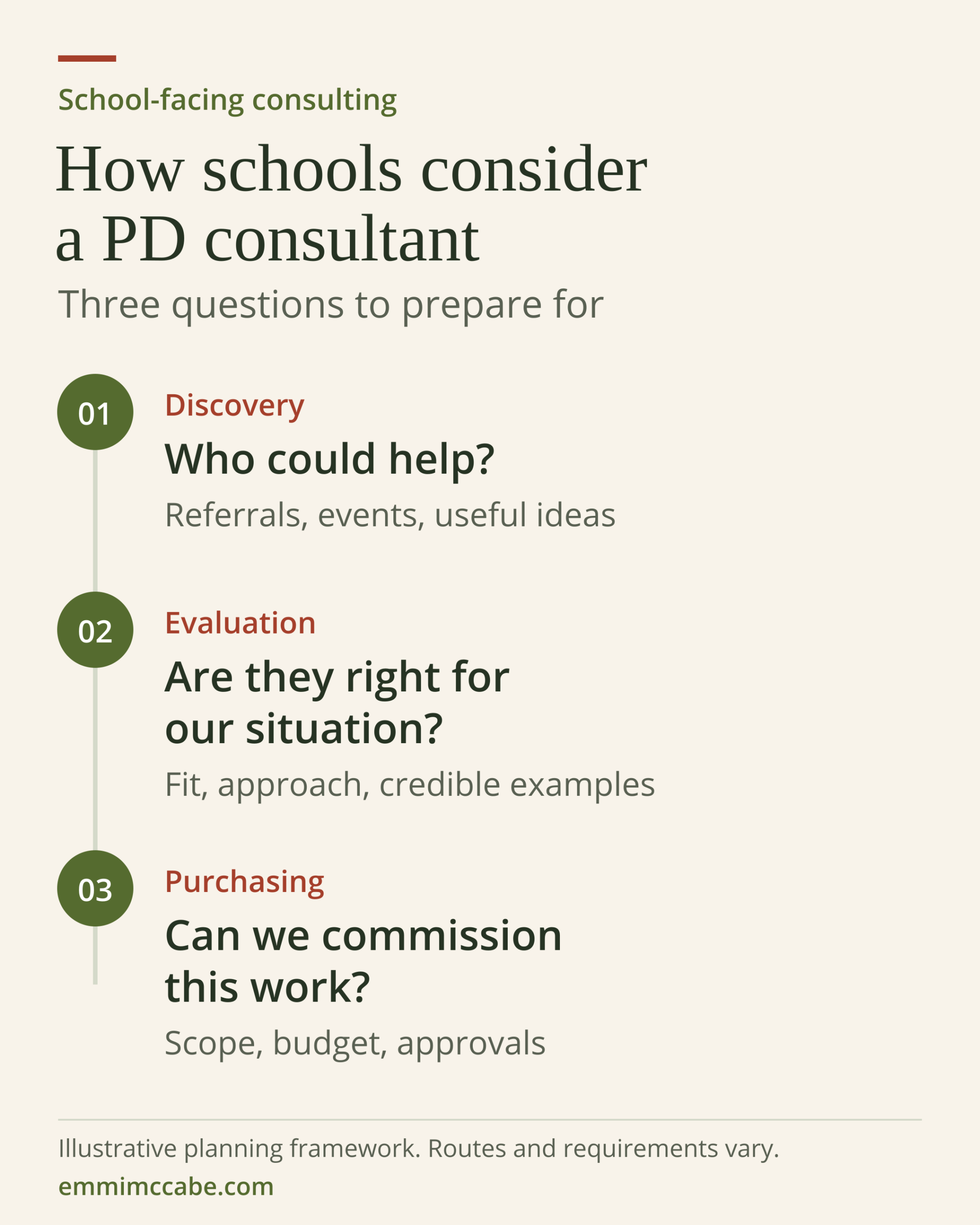
For an established K–12 consultant, the practical task is to help people answer three questions: Who could help? Are they right for our situation? Can we commission this work?
What problem is the school actually trying to solve?
A request for “a workshop on feedback” is a starting point. The underlying concern might be inconsistent assessment practices, students struggling to use feedback, or teachers overwhelmed by marking. Those situations call for different responses.
Learning Forward’s Resources standard connects professional-learning investments with school and system priorities. It also asks leaders to consider time, people and other resources, and to monitor the impact of those investments.
That has a straightforward implication for your marketing: describe the situations in which your work is useful.
“Professional development for educators” leaves a prospective client with a great deal to work out. A more specific description might be: “I help secondary teaching teams develop feedback routines that students can use to revise their work.” This is a hypothetical positioning example, not a promise of results.
The second description gives a leader something to recognize. It also gives a colleague language they can use when recommending you.
Start by looking at your last few suitable projects. What prompted the inquiry? Who noticed the problem? What had the school already tried? Use those details to explain your work in terms a future client will understand.
Where might a school first come across your work?
Think about several possible entry points rather than assuming every client will start on your homepage:
- A former client or professional colleague recommends you
- A leader attends your conference session or webinar
- Another consultant brings you into a project needing your expertise
- Someone reads your article, book or interview
- A school searches a relevant directory or approved-provider list
This is a planning checklist, not a ranking of how frequently schools use each route. There is no reason to assume the same mix applies to every specialty or market.
Provider lists also serve different purposes. Colorado’s 2026–27 School & District Support Advisory List is designed to support schools and districts with low-performing schools. Its categories include targeted professional learning. CDE describes a review of applications, work samples, evidence of prior impact and references. That is a specific school-improvement context, not a general directory for every education consultant.
Look for the routes that fit the work you already do well. If your strongest projects come through other consultants, make your specialty easy for those peers to explain. If school leaders encounter you through speaking, give them a useful place to go after the session.
What helps a leader decide whether you are a good fit?
Being familiar with your name and understanding your approach are different stages. Your public materials should help someone move between them.
A prospective client needs enough detail to have a useful initial conversation:
- Which educators and age ranges do you work with?
- What school-level challenge do you address?
- What will participants actually do during the work?
- How do you adapt to their curriculum, experience and priorities?
- What support is available after an initial session?
- What relevant experience and evidence can you share?
For a concrete example of formal evaluation, Reynolds School District’s 2022 coaching-model RFP requested ongoing support for teacher leaders and administrators. It asked applicants about comparable projects, the proposed team, references, an implementation timeline, deliverables and costs. The scope also included a way to examine the effectiveness of the services.
That was a particular districtwide project with a software component. Its requirements should not be treated as a universal checklist for a visiting speaker or a small workshop. Its relevance here is the practical detail a buyer needed to assess a substantial engagement.
For your own business, prepare proportionate answers. A short, well-explained example of similar work may be more helpful in an early conversation than a large folder of unrelated testimonials. Describe the starting situation, what you contributed and what you can reasonably say about the outcome.
How is purchasing different from choosing a consultant?
The person who wants your expertise may need other people to approve the budget, establish you as a vendor or arrange a contract. Ask about that process early enough to plan around it.
Plano ISD’s February 4, 2025 agenda item for professional-development providers illustrates another approach. It describes establishing approved vendors for speakers, consultants, trainers and related services. Staff could then request quotes to determine best value for district needs. In that model, inclusion in the pool is one step; a particular piece of work still needs to be selected.
Public-district purchasing processes also differ from those of independent and international schools. Avoid building your entire sales process around one district’s example.
Ask your prospective client:
- “Who else needs to review the proposed work?”
- “Is there a vendor-registration, quotation or formal proposal process?”
- “What information would help you discuss this internally?”
- “What needs to be approved before we agree delivery dates?”
If a formal solicitation is open, follow its stated communication and submission rules. A personal relationship does not replace those requirements.
What does this look like in an actual inquiry?
Consider a hypothetical consultant who supports instructional coaches.
A district leader hears her speak about helping coaches lead productive conversations with teachers. Later, the leader shares her website with a colleague responsible for professional learning.
The website explains whom she works with, shows a sample coaching activity and describes a previous engagement with the client’s permission. Her contact form makes it easy to explain the district’s situation.
During the first conversation, she learns that the district already has a coaching framework. It needs help with implementation, particularly how new coaches prepare for difficult conversations. She proposes support that builds on the existing framework and asks how purchasing decisions are made.
Notice what each step contributes. The presentation creates familiarity. The website helps a second person evaluate her work. The conversation clarifies the need. The proposal and purchasing process establish the scope and terms.
The sequence will not always be this tidy. A referral may arrive with an urgent request for a quote. A formal proposal may introduce you to a district that has never heard of you. You still need clear answers at each stage.
What should you improve first?
Choose one service you want to be known for and review the path a prospective client would take.
Can a colleague explain when to recommend you? Can a school leader understand your approach without arranging a call? Could you respond to a suitable inquiry with a relevant example and a clear description of the work?
Start with the weakest answer. You may need a clearer service description, a useful example or a better way to explain the next step. More promotion will be easier to use once those pieces are in place.
If your experience is stronger than the way it currently comes across online, get in touch to talk about presenting your expertise more clearly.